
March Comes in Like a Female Lion
- Juno

- Mar 31, 2022
- 3 min read
3-gatsu no Lion (March Comes in Like a Lion in English) is the masterpiece of manga writer Chica Umino, a Japanese female manga artist, designer and illustrator who has been awarded several times thanks to this piece of work and many others. 3-gatsu no Lion narrates the story of Rei Kiriyama, a 17-year-old professional shogi player who struggles to survive in the world of this game while trying to overcome hardships from the past that have haunted him to the present day. From abuse and depression to fulfillment and youth romance, 3-gatsu no Lion explores a wide range of emotions and events humans—especially young people—go through in their lives.
3-gatsu no Lion tells the story of how Rei Kiriyama fights depression as he challenges himself to overcome it. In any case, he would not be able to do it alone but would need the support and encouragement of his friends. While left high and dry in the streets of Sangatsu-chō (the name of the district he was in), Rei meets Akari Kawamoto, a young woman who takes him to her house. Rei meets the Kawamoto sisters: Akari, Hinata and Momo, a hostess, a middle-schooler and a preschooler respectively. This trio of kind-hearted girls is the protagonist of this analysis of 3-gatsu no Lion, a manga that, from my standpoint, conveys the hardships of women, how they get through difficult times and face life as the hunter lions in a pride called “family.” Let us begin an overhaul of how women are portrayed in 3-gatsu no Lion and why this piece of work is a chef-d'œuvre of modern manga.
In the first instance, 3-gatsu no Lion shows the different sides of women other than the ones primarily portrayed in artwork produced by men. The Kawamoto sisters, Akari, Hina and Momo have different personalities and traits, making them feel like women with ordinary lives other than living to the purposes of the plot. Chica Umino, the author of this series, managed to write female characters that are true women, not objects looked through a lens of a patriarchal society. Whilst most female characters in manga are depicted as superficial, cute, heart-warming and often silly characters who live for the male protagonist, 3-gatsu no Lion shows that women can also be furious, empowered, independent lions who do not need a pride male.

On the other hand, following the previous instance, 3-gatsu no Lion deconstructs the misconception that feminism means being less feminine. Defined as having the characteristics of traditional female conceptions, feminity is often criticized as a patriarchal prejudgement against the roles of women in society. However, this manga shows that women are not totally the opposite of many (inaccurate) perceptions. Chica Umino narrates, although from the perspective of a male character, an accurate female perspective of a girl falling in love with a boy from her class. In this romance, women are not the object anymore. The most renowned romance stories from manga are narrated by men from the standpoint of men, who end up being the core of the plot. In 3-gatsu no Lion, it is a primarily male yet realistic point of view that diminishes the presence of the male protagonist to deepen the story of the female characters.
“March comes in like a lion and leaves like a lamb.”
Finally, the name of the manga has its origins in a proverb about March coming in like a lion, because of the rough, harsh winter weather at the beginning of the month; and leaving like a lamb, because, in the end, things end up clearing up. A possible way to interpret the meaning of this proverb applied to the story of 3-gatsu no Lion is how women in this manga are like March. Women in this manga are usually like lambs who warm the heart of both the protagonist and the readers, but they can also become furious lions, devouring everything and everyone around them.
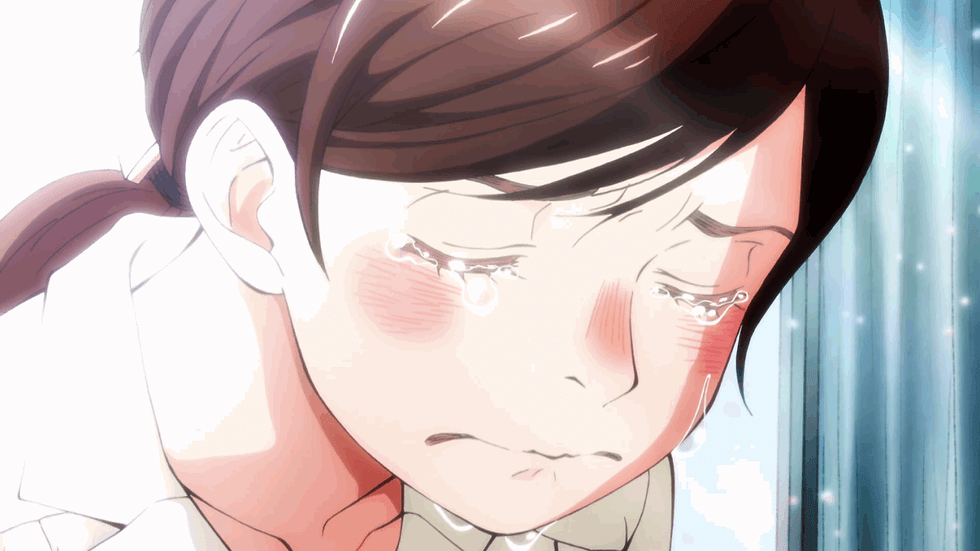
In conclusion, I consider 3-gatsu no Lion to be a manga that knows how to accurately portray the roles of women aside from any misconceptions and patriarchal bias. Chica Umino, the author of this series, a female mangaka who, like many others, has to deal with publishing in a market almost completely ruled by men, managed to show the world her perception of women—how women are lions that cannot be controlled by men.
Comments